

Are We Overcomplicating Healthy Snacks?

Does a snack really need to be “high-protein, keto, gluten-free, sugar-free, superfood-powered and functional” to be healthy?
Somewhere along the way, healthy snacking became surprisingly complicated.
Walk into a supermarket today and you may find snacks promising everything from gut health and immunity to protein, collagen, ancient grains, adaptogens and a dozen other benefits. There is nothing wrong with innovation. But sometimes, in our search for the perfect healthy snack, we forget something rather simple:
Food doesn't always need a complicated story to be good food.
Maybe our grandparents had a point
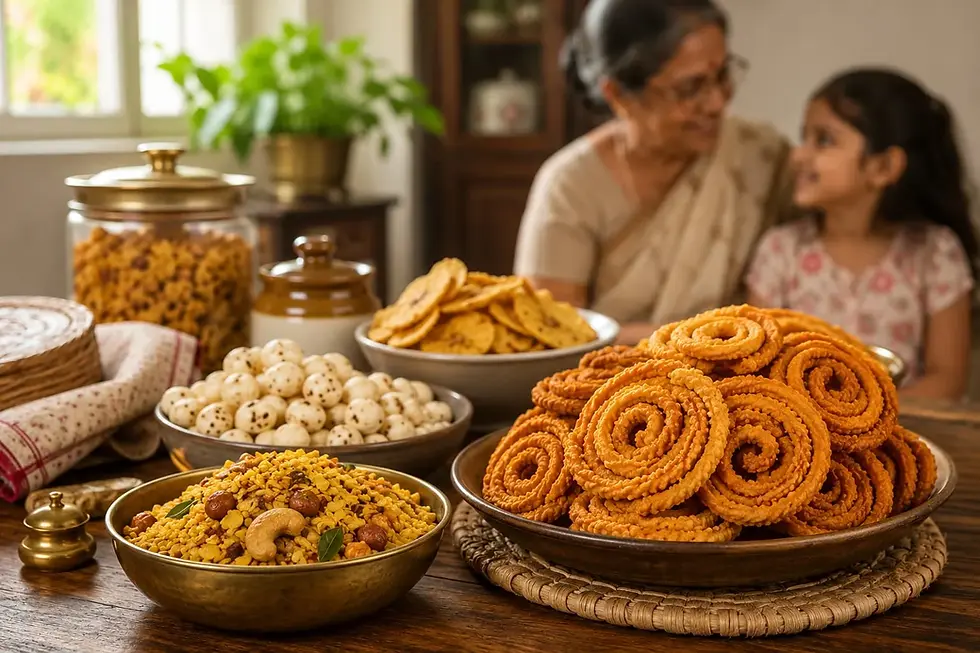
Think about some of the snacks many of us grew up eating.
Roasted chana
Makhana
Peanuts
Chikki
Poha chivda
Khakra
Homemade chakli
Roasted nuts and seeds
Laddoos made at home
Freshly made mathri or namkeen enjoyed occasionally
These foods weren't marketed as “functional foods.”
There were no elaborate claims on the packet. No ingredient combinations designed to sound scientific. No promise that one bite would transform your gut microbiome.
They were simply familiar foods made with familiar ingredients.
And perhaps that's worth remembering.
Healthy doesn't have to mean complicated
A healthy snack can be as simple as:
A handful of roasted chana.
or
Peanuts + jaggery.
or
Roasted makhana with a little seasoning.
or
A homemade millet or whole-grain snack made with ingredients you recognise.
The point isn't that every traditional snack is automatically healthy. Some can be high in sugar, salt or fat depending on how they're prepared.
The point is that healthy eating is ultimately about the overall quality, quantity and frequency of what we eat—not how impressive the label sounds.
The “more is better” trap
We've also started equating more nutritional claims with better food
High protein? Good.
High fibre? Good.
No added sugar? Good.
Gluten-free? Good—if you need it.
Keto? Useful for some people following that dietary approach.
But adding more and more claims doesn't automatically make a product healthier.
A snack containing 15 ingredients, five functional powders and a long list of claims isn't necessarily better than one made from five recognisable ingredients.
Sometimes less is more.
Let's talk about ingredients
One of the simplest ways to think about a snack is to ask:
Do I understand what I'm eating?
Can I recognise most of the ingredients?
Is the product freshly made or appropriately preserved for its intended shelf life?
Is the ingredient list unnecessarily long?
Does it contain excessive amounts of sugar, salt or fat for the portion?
Does the snack fit into my overall diet?
These questions can be much more useful than simply looking for a big “HEALTHY” claim on the front of the packet.
And what about kids?
This becomes even more important when we're choosing snacks for children.
Kids don't necessarily need a snack that sounds like a nutrition textbook.
They need something that tastes good enough to eat while fitting sensibly into their overall diet.
Roasted chana can be fun.
Homemade granola bars can be fun.
Fruit and nut bites can be fun.
Colourful vegetable-based snacks can be fun.
And yes, occasionally, even a traditional homemade treat can have a place.
The goal doesn't have to be:
“How do I make my child eat perfectly?”
Perhaps it can simply be:
“How do I make everyday choices better and easier?”
Healthy snacking is also about convenience
There's another reality we often overlook.
Most people aren't choosing snacks while sitting at a nutrition seminar.
They're choosing them:
Between meetings
During an office break
While travelling
Packing a child's school snack
During an evening craving
While watching a movie
When guests suddenly arrive
When they simply don't have time to cook
That's why healthy snacking needs to be practical, not just nutritionally impressive.
If a snack is healthy but impossible to find, inconvenient to store, expensive, or nobody actually enjoys eating it, it isn't going to become part of everyday life.
So, what should we look for?
Instead of asking:
“Is this the healthiest snack I can possibly buy?”
Try asking:
“Is this a better choice for this moment?”
Look for snacks with:
✓ Familiar, recognisable ingredients
✓ Sensible portions
✓ Appropriate levels of sugar and salt
✓ Minimal unnecessary additives
✓ Good quality ingredients
✓ Freshness and proper storage
✓ A taste you'll actually enjoy
✓ A place within your overall eating pattern
And most importantly:
Don't let the pursuit of perfect nutrition make everyday eating stressful.
Maybe healthy snacking should feel more… normal
We don't need to turn every snack into a superfood.
We don't need to fear every traditional ingredient.
We don't need a new nutritional trend every month.
And we certainly don't need to feel guilty every time we eat something that isn't “perfect.”
Perhaps the future of healthy snacking isn't about making food more complicated.
Perhaps it's about making better food simpler to discover, understand and enjoy.
That's the idea behind GoodMunchyBasket.
We believe snacks can be homestyle, thoughtfully made, clean and delicious without needing to be complicated.
Because sometimes, the best snack is simply one that feels like food.
Simple ingredients. Familiar flavours. Thoughtfully made.
Kyonki.. har snack should feel ghar jaisa.


Comments